
Introduction
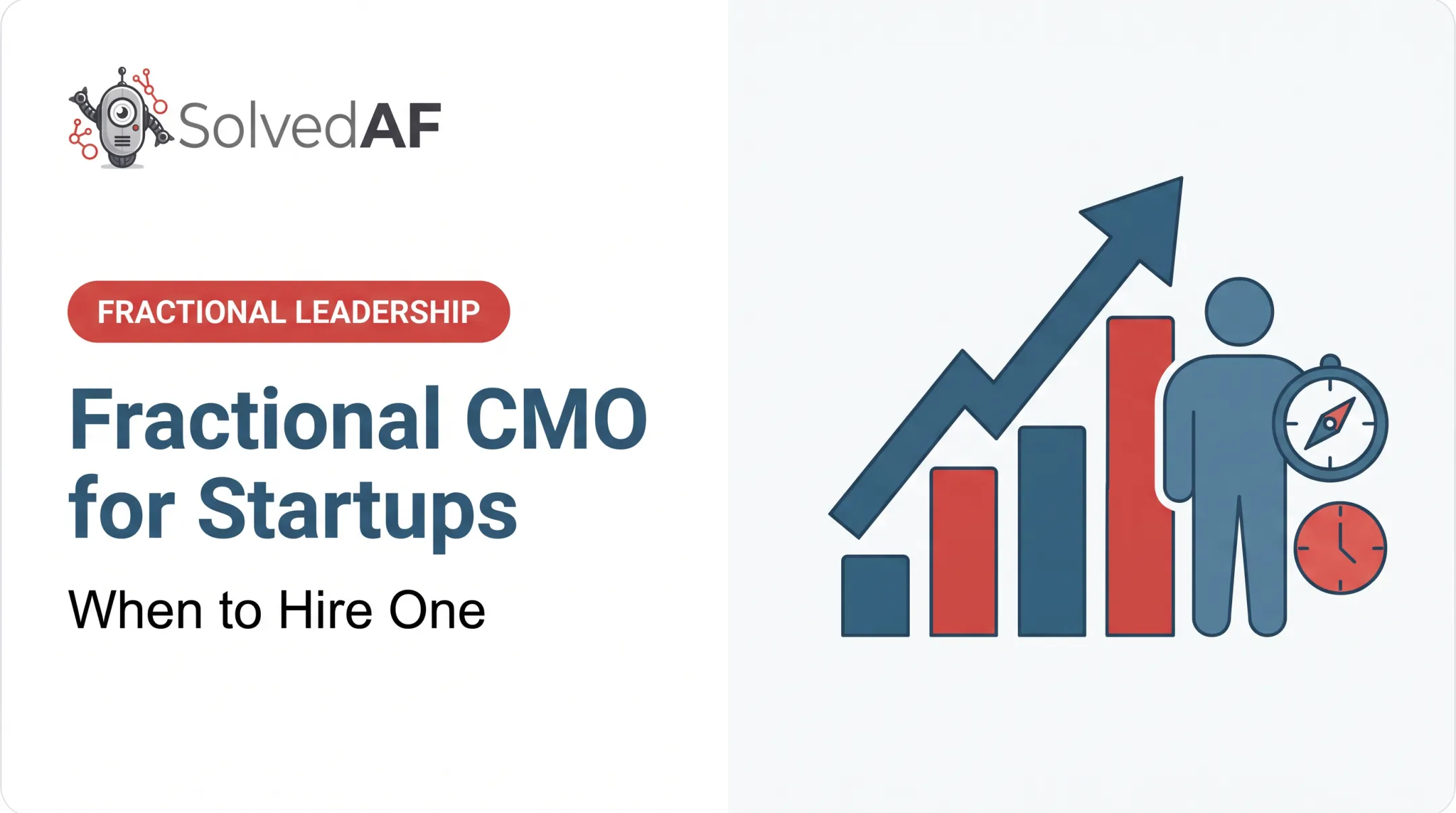
Marketing drives growth, but most Canadian startups, SMEs, nonprofits, and scaleups don't need a full-time Chief Marketing Officer. A permanent CMO hire means six-figure compensation, months of recruiting, and overhead many growing businesses simply aren't ready to carry.
Yet without senior marketing leadership, campaigns stay inconsistent, positioning stays fuzzy, and pipeline stalls.
Fractional CMO services close that gap. You get senior marketing leadership on a part-time, contract, or flexible basis—without the cost or commitment of a full-time executive hire.
This article covers:
- What fractional CMOs actually do
- When hiring one makes sense
- How the model compares to agencies and freelancers
- What engagements typically cost
- How to evaluate a provider before you sign on
Key Takeaways
- Fractional CMOs deliver senior marketing leadership and decision-making without a full-time executive hire.
- The role goes beyond freelance work: it covers team leadership, vendor oversight, budget ownership, and cross-functional alignment.
- Best fit when you need marketing direction now but cannot justify a permanent CMO yet.
- Success is measured by pipeline quality, conversion rates, and marketing maturity—not vanity metrics.
What Are Fractional CMO Services?
"Fractional" means a senior marketing executive contributes a defined, limited amount of time rather than working as a traditional full-time employee. Forbes cites one real-world example of 10 to 15 hours per week, though arrangements vary widely by provider and scope.
How It Differs From Other Marketing Roles
Businesses often confuse fractional CMOs with similar-sounding alternatives. Here's the practical distinction:
- Marketing consultant: Advises on strategy but typically doesn't manage teams or own execution.
- Freelancer: Delivers a defined specialist task (a campaign, a website, a content batch) without ongoing leadership responsibility.
- Marketing agency: Provides channel execution and production capacity, not executive-level accountability.
- Interim CMO: Usually full-time and short-term, brought in specifically to cover a vacancy.
- Fractional CMO: Embedded, part-time leadership that sets direction, manages people, and stays accountable for outcomes over an ongoing or defined period.
That embedded accountability is what separates the model from pure advisory work. Fractional leadership firm Authentic describes its CMOs as leaders who integrate with the organization and stay responsible for execution, rather than handing off a report and moving on.
Scope Varies by Need
Engagements range from a short-term strategic reset or product launch to ongoing part-time leadership lasting a year or more. The right scope depends on:
- Business goals and growth stage
- Internal marketing capability
- Sales complexity
- Available budget
- How much day-to-day involvement the business actually needs
A seed-stage SaaS startup might need six months of positioning and go-to-market work. A scaling nonprofit might need ongoing quarterly leadership to keep campaigns aligned with fundraising targets. Both fit the fractional model; they just look different in practice.
What Does a Fractional CMO Do?
Most engagements start with a diagnostic phase, not a jump into execution.
Diagnosis and Strategy
A fractional CMO typically reviews:
- Business objectives and target customer definitions
- Current positioning and messaging
- Funnel performance and conversion data
- Existing channels and vendor relationships
- Internal team capability and technology stack
- Budget allocation and reporting structure
From there, they build or refine a strategy tied directly to business priorities: ideal customer profile, positioning, go-to-market direction, channel priorities, and campaign sequencing over time.

Leadership and Coordination
This is where fractional CMOs differ most from freelancers. They set priorities across the marketing function, manage internal marketers, coordinate external agencies and vendors, and mentor junior team members.
A 2024 Forbes communications panel notes the role often bridges marketing, sales, product, and customer success—teams that frequently operate in silos without senior oversight.
Connecting Marketing to Revenue
A fractional CMO defines a measurement framework that ties marketing activity to commercial outcomes. In practice, this means:
- Improving CRM and marketing-automation visibility
- Reporting on funnel metrics that connect to revenue, not just traffic or impressions
- Setting KPIs the executive team actually agrees on, rather than generic benchmarks
Forbes' 2024 expert panel on fractional CMO success specifically recommends establishing mutually agreed KPIs and realistic timelines with the CEO and leadership team before work begins. Skipping this step is one of the most common reasons engagements underdeliver.
Execution Areas and Technology Fluency
Depending on the engagement, a fractional CMO may oversee:
- Demand generation and content
- Paid and organic channels
- Email and lifecycle marketing
- Brand development and events
- Sales enablement
Exact scope varies by provider and contract.
Modern fractional CMOs also need literacy in marketing technology and AI. That covers responsible tool evaluation, workflow automation, data quality, and privacy considerations—especially relevant for Canadian businesses managing customer data under provincial and federal privacy rules.
Why and When Should a Business Hire a Fractional CMO?
Signals You May Need One
- Marketing activity happens inconsistently, with no clear owner driving it
- Positioning feels unclear or keeps shifting
- Pipeline has stalled despite spending on ads or content
- Vendors and freelancers operate disconnected from each other
- Sales and marketing teams aren't aligned on priorities
- The founder is still personally running marketing decisions
Who Benefits Most
Startups, SMEs, and nonprofits often need executive judgment but can't yet justify a permanent CMO's salary and overhead. Funded scaleups use the model differently: building out their executive bench or testing the role before committing to a full-time hire.
A 2026 survey of 113 fractional marketing leaders, mostly UK-based, found that 33.9% believed demand had grown because businesses wanted senior expertise without long-term commitment, while 18.6% pointed to cost efficiency. These are practitioner perspectives rather than confirmed Canadian adoption data, but the underlying logic applies broadly: businesses want senior judgment without the fixed cost.

Time-Sensitive Use Cases
- A CMO vacancy that needs temporary coverage
- Market expansion or a new product launch
- Funding rounds requiring investor-ready positioning
- Restructuring or acquisition integration
- A strategic reset after stalled growth
The Trade-Offs
Fractional leadership isn't a universal fix. Know the limits:
- Part-time availability means the CMO isn't present for every daily decision
- Internal execution capacity still needs to exist somewhere
- Onboarding takes time, even for experienced leaders
- Unclear authority or mismatched expectations can derail the engagement early
Quick decision checklist: a fractional CMO is usually the right fit when:
- Urgency is high and leadership is needed soon
- Budget can't support a full-time CMO yet
- Your internal team can execute but lacks direction
- The gap is leadership, not hands-on production
Fractional CMO vs. Other Marketing Options
Choosing marketing leadership is less about labels and more about ownership, cost, and how fast you need to move. This side-by-side shows how a fractional CMO compares with a full-time hire, a freelancer, and an agency.
| Factor | Fractional CMO | Full-Time CMO | Freelancer | Marketing Agency |
|---|---|---|---|---|
| Commitment | Part-time, defined hours | Full-time, ongoing | Project-based | Retainer or project |
| Cost structure | Hourly, retainer, or scoped | Salary + benefits | Hourly or flat fee | Retainer or project |
| Hiring timeline | Weeks | Months | Days to weeks | Weeks |
| Strategic ownership | Yes | Yes | Rarely | Sometimes |
| Team integration | Embedded, part-time | Fully embedded | Minimal | Limited |
| Scalability | Flexible as needs shift | Fixed cost regardless of need | Limited to scope | Depends on contract |
When In-House Still Wins
An in-house CMO makes more sense when you need continuous executive presence, deep daily team management, or long-term institutional ownership of marketing. Talentfoot's 2025 analysis estimates full-time CMO hiring takes roughly 3.8 months on average in the U.S. market—before onboarding ramp-up.
Freelancers and Agencies Aren't Substitutes
A freelancer handles a defined deliverable—a website redesign or content sprint—without owning priorities or outcomes. An agency brings channel execution and production capacity, but rarely sets strategic direction or owns business results.
A strong hybrid is common: a fractional CMO sets priorities and holds the roadmap while an agency runs execution.
Don't Shop on Hourly Rate Alone
A lower hourly rate means little without seniority, availability, or implementation support. Judge options on:
- Scope of work actually covered
- Strategic ownership of priorities and outcomes
- Reporting discipline and decision cadence
- Expected business results—not only the invoice
How to Evaluate and Start a Fractional CMO Engagement
Choosing a fractional CMO is less about credentials on paper and more about fit, decision rights, and a plan you can measure. Use the checklist, interview questions, and first-90-days frame below before you sign.
Provider Selection Checklist
Look for:
- Experience at your business stage (startup, scaleup, non-profit)
- Familiarity with your industry or buyer type
- Strong executive communication skills
- Ability to move from strategy into actual execution
- Depth to manage both internal teams and external vendors
- Comfort with marketing technology and data platforms
- Verifiable references
- Confidentiality practices and reporting discipline
Questions to Ask Candidates
- How would you diagnose our current marketing position in the first 30 days?
- What would you prioritize first, and why?
- How do you define an early win within 60 days?
- How would you work with our existing staff and vendors?
- How will you measure progress by day 90?
What Strong Onboarding Establishes
Before work starts, both sides should agree on:
- Goals and success definitions
- Decision-making authority
- System and stakeholder access
- Expected deliverables and meeting cadence
- Communication channels and escalation paths
- Budget authority limits
A Practical First-90-Days Framework
Harvard Business School alumni executive-transition guidance recommends structuring new leadership roles in three 30-day increments. Applied to fractional CMO work, that typically looks like:
- Days 1–30: Assess the current state and align with leadership on priorities
- Days 31–60: Build the roadmap and improve foundational processes (CRM visibility, reporting, team workflows)
- Days 61–90: Launch or optimize agreed initiatives and establish ongoing KPI reporting

KPIs should connect marketing directly to commercial goals—pipeline quality, conversion rates, and acquisition efficiency—rather than generic activity metrics. The right benchmarks depend on your business model, so request specifics from any provider you're evaluating rather than relying on industry averages.
Businesses that need fractional leadership alongside technology, AI, finance, operations, risk, or compliance support can also look at integrated advisory models.
SolvedAF, for example, provides fractional executive leadership across CFO, CIO, CTO, COO, and CISO roles, paired with right-sourced onshore and offshore execution teams. Strategy and implementation stay connected under one coordinated engagement instead of spreading across disconnected vendors.
Frequently Asked Questions
How much does a fractional CMO charge per hour?
Rates vary by seniority, geography, industry complexity, and whether execution support is included. Request a scoped proposal tied to your needs, scope, and region.
How much does it cost to hire a fractional CMO?
Most engagements use hourly billing, monthly retainers, or project fees. Total cost tracks time commitment, scope of responsibilities, and whether specialist support is bundled—ask for a quote built around your requirements.
Where can I find a fractional CMO?
Reputable routes include referrals, investor and advisor networks, professional associations, specialized fractional leadership firms, and consulting providers. Verify experience, references, availability, and implementation capability before committing.
What does a fractional CMO do?
They handle strategic planning, positioning, go-to-market direction, team and vendor leadership, marketing operations, and KPI reporting, keeping marketing aligned with broader business goals.
What are the responsibilities of a Chief Marketing Officer (CMO)?
The broader CMO mandate includes marketing strategy, brand and market positioning, demand generation, customer growth, budget allocation, team leadership, and accountability for marketing performance across the organization.
What is the average fractional CMO salary?
Fractional CMOs usually bill as contractors, so earnings depend on client load and rates—not a fixed salary. For context, Robert Half’s 2026 Canadian guide puts the full-time CMO national midpoint at $188,750 CAD.