
Employee outsourcing means using an external provider or professional to do work that might otherwise sit with a direct employee. Depending on the arrangement, that provider might recruit the worker, employ them, manage their day-to-day tasks, or some combination of all three.
This article breaks down how the model actually works, where it delivers value, where it creates risk, and what Canadian organisations should check before signing anything.
Key Takeaways
- Outsourcing adds skills and capacity without full HR, payroll, or recruitment overhead.
- Map who employs the worker, directs the work, and owns taxes, benefits, and compliance.
- Scope, accountability, and service levels belong in writing before work starts.
- Lowest price rarely wins on total value once quality and continuity count.
What Is Employee Outsourcing and How Does It Work?
Employee outsourcing differs from hiring a permanent employee in one key way: an external provider supplies the person, team, or service, and you pay the provider under a contract rather than running payroll yourself.
Before anything else, three relationships need to be clear:
- The legal employer — whoever is responsible for employment administration, tax withholding, and statutory obligations.
- The directing organization — whoever sets daily priorities and manages the actual work.
- The provider — whoever handles recruitment, payroll, benefits, or supervision on the backend.
A Typical Outsourcing Lifecycle
Most engagements follow a similar path:
- Identify the problem — decide whether you need a single role, a specific task, or a full function handled externally.
- Define the scope — working hours, reporting lines, system access, deliverables, and how success will be measured.
- Select and onboard — vet a provider, sign the agreement, bring the worker or team on board, and review performance regularly.

Staff Augmentation vs. Business Process Outsourcing
These two models get confused constantly, but they're not the same thing:
- Staff augmentation supplies people who work closely with your team, often following your daily direction.
- Business process outsourcing (BPO) hands responsibility for an entire function or outcome to the provider.
Consider a growing Canadian accounting firm bringing on outsourced bookkeeping support. The firm's leadership still owns client relationships, approvals, and strategic decisions. The outsourced team handles the transactional workload underneath.
SolvedAF's work with M. Saini CPA followed this pattern: offshore staff augmentation added bookkeeping and reconciliation capacity while the firm's partners kept control of client-facing decisions and quality sign-off.
Whatever arrangement you choose, the contract should spell out:
- Worker classification, payment, taxes, and benefits
- Confidentiality, intellectual property, and equipment
- Leave, termination, and dispute resolution
- Who is liable for workplace incidents
For employees, contractors, or cross-border work, get Canadian legal or HR advice before you sign.
Employee Outsourcing Models: Which Arrangement Fits?
Location matters less than most people assume.
Onshore outsourcing (a Canadian provider or worker) tends to simplify legal familiarity, language, time zones, and collaboration.
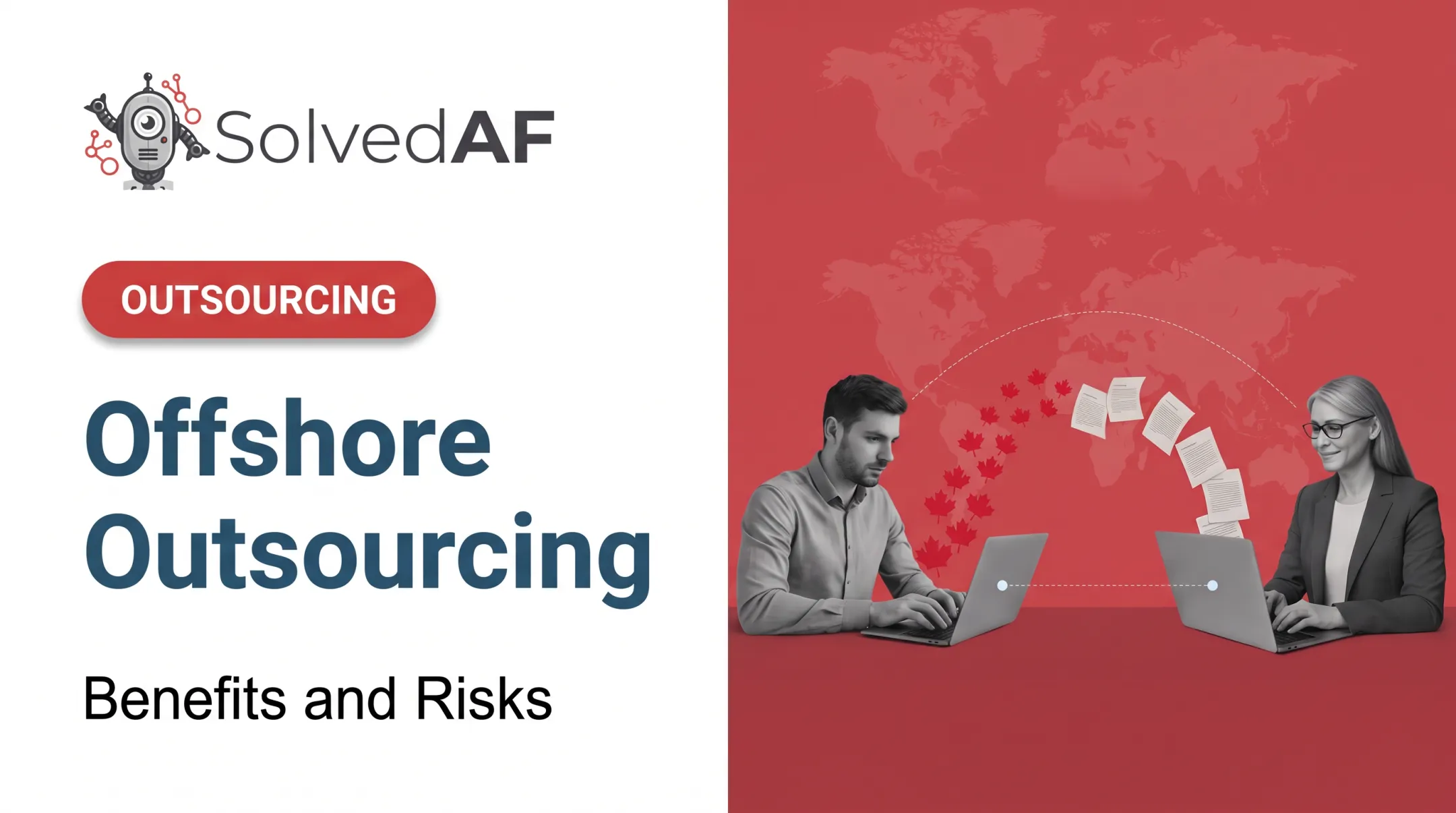
Offshore and nearshore outsourcing lower cost in many cases, but they add due diligence. Review foreign employment law, tax treatment, privacy obligations, and data-transfer rules before you commit.
Here's how the main arrangements stack up:
| Model | Who employs the worker | Who directs daily work |
|---|---|---|
| Traditional outsourcing / BPO | Provider | Provider |
| Staff augmentation | Provider (typically) | Client |
| Employer of record (EOR) | EOR entity | Client |
| Independent contractor | The contractor (self-employed) | Shared, per contract |
| Direct hiring | The organisation | The organisation |
One caution: labels don't determine legal status. The Canada Revenue Agency looks at the actual working relationship—degree of control, who provides tools, financial risk, and opportunity for profit—not what the contract calls someone.
Either the payer or the worker can request a CRA ruling if classification is unclear. Get this wrong and the employer can end up liable for unremitted CPP and EI contributions, plus interest and penalties.
An employer of record arrangement also isn't a blanket regulatory exemption. A third party formally employs the worker for payroll and administration. Your organisation still manages day-to-day work and still needs to understand the applicable provincial obligations underneath it.
Why Do Organisations Outsource Employees? Benefits and Risks
Outsourcing isn't automatically cheaper or automatically riskier. It depends entirely on execution.
The Upside
- Specialised skills on demand: accounting, AI, compliance, or technical support that's hard to recruit internally.
- Flexibility: scale up for seasonal demand, a project, or expansion without a permanent headcount commitment.
- Lower overhead: lower recruitment, infrastructure, and payroll-admin costs when you measure total cost of delivery, not the rate card alone.
- Freed-up internal capacity: leaders and staff spend more time on strategic, revenue-generating work.
- Access to mature processes: playbooks, tooling, and specialist oversight a smaller organisation hasn't built yet.
In Q1 2025, 52.2% of Canadian businesses reported contracting out tasks, projects, or short contracts in the prior 12 months, rising to 64.8% among businesses with 20-99 employees. That figure covers contracting broadly, not only outsourced-employee models, but it shows how normal external capacity has become for growing Canadian organisations.

The Downside
- Reduced visibility when the provider's reporting or escalation process is weak.
- Accountability confusion over who approves leave, manages performance, or responds to a workplace incident.
- Security exposure when external parties get access to systems or sensitive data.
- Cultural disconnection if outsourced staff feel separate from the core team.
- Vendor dependency: knowledge loss or disruption if the relationship ends abruptly.
IBM's 2025 research found third-party vendor and supply-chain compromise accounted for 15% of studied breaches, averaging US$4.91 million each.
A proper total-cost view includes fees, recruitment, benefits, payroll, software licences, equipment, training, management time, compliance, security controls, cross-border costs, and exit planning. None of that shows up on a vendor's rate card.
Outsourcing transfers work, not accountability for how people are treated. Fair pay, safe conditions, clear communication, and responsible supervision remain your problem even when someone else signs the paycheque.
What Work Can Be Outsourced?
Not every function is equally suited to outsourcing. Common categories include:
- Finance and accounting: bookkeeping, accounts payable/receivable, payroll support, reporting, controller or CFO support.
- Technology and data: software development, IT support, cybersecurity, automation, analytics, AI implementation.
- Administration and operations: virtual assistance, customer support, scheduling, documentation, back-office processing.
- People, risk, and compliance: recruitment support, policy development, risk assessments, privacy work, certification readiness.
A function tends to be a strong outsourcing candidate when the work is repeatable, measurable, remote-friendly, specialised, or capacity-constrained, and when it is not your organisation's core competitive advantage.
It's a poor fit when the work requires constant on-site presence, deep cultural stewardship, or capabilities that must stay embedded in the organisation long-term.
Before you decide, pressure-test the choice with four questions:
- What outcome do I actually need?
- How much control do I need to retain?
- How sensitive is the information involved?
- Do I need a provider-managed service, or embedded talent that works inside my team?
SolvedAF's engagement with Mercana sits at the repeatable, measurable end of this spectrum. Specialists handled high-volume invoice processing, collections, and payment execution, and automated workflows replaced manual handling and inconsistent approvals.
How to Choose and Implement an Outsourcing Arrangement in Canada
Before You Sign Anything
Start with an honest internal assessment:
- Define the objective, budget, timeline, and whether the need is temporary or ongoing.
- Map current processes, dependencies, and approvals before transferring any work out.
- Identify what information can't be shared and what compliance requirements apply to your industry or province.
Vetting a Provider
Ask for clear answers on:
- Relevant experience and client references
- Financial stability and service continuity plans
- Recruitment, vetting methods, and worker treatment
- Insurance coverage and any subcontractor use
A provider that can't answer these clearly is telling you something.
What the Contract Needs to Cover
A solid agreement and service-level schedule should address:
- Scope, deliverables, response times, quality measures, reporting, escalation, and termination.
- Ownership of work product, confidentiality, data storage, breach notification, and return or deletion of information.
- Responsibility for payroll, taxes, benefits, worker classification, and workplace health and safety.
Onboarding and Ongoing Governance
Treat outsourced workers like an extension of the team, not a black box:
- Introduce them to internal stakeholders and give role-specific system access.
- Establish regular communication routines and name an internal point of contact.
- Include them in relevant meetings without over-exposing sensitive information.
Then keep governing with:
- Regular performance reviews and quality checks
- Periodic access reviews
- A documented contingency plan if the relationship ends
This is where a tailored approach tends to outperform a generic package. SolvedAF's right-sourcing process runs through four phases: Discovery & Planning, Integration, Execution, and Performance Monitoring.

That model matches startups, SMEs, and nonprofits with fractional leadership, accounting, technology, or risk support instead of a generic outsourcing contract. Whether it's the right fit depends on your scope and accountability needs.
Conclusion: Is Employee Outsourcing Right for Your Organisation?
Employee outsourcing is an operating-model decision, not just a cheaper-labour shortcut. The right arrangement balances capability, control, cost, compliance, security, and how outsourced workers are actually treated.
Outsource when an external partner can deliver defined value without creating accountability gaps or data risk you can't manage. Keep work internal when it's central to your culture, strategy, or sensitive decision-making.
Your next steps:
- Document the role or function clearly
- Decide which outsourcing model fits
- Calculate the total cost of the arrangement
- Get Canadian legal or HR advice
- Compare providers against requirements you can measure
Frequently Asked Questions
What does it mean to outsource employees?
It means using an external provider to perform work instead of hiring and managing everyone on your own payroll. Legal employment and day-to-day management may sit with different parties, so clarify both in the agreement upfront.
What is the minimum salary for outsourcing employees?
There's no universal outsourcing salary. Compensation depends on the role, location, worker classification, and applicable federal or provincial employment standards, so avoid relying on one unsupported figure.
Is employee outsourcing the same as hiring an independent contractor?
No. Outsourced employees, contractors, staff augmentation, and provider-managed services are distinct arrangements. Canadian classification depends on the actual working relationship, not the label used in the contract.
What are the main benefits of employee outsourcing?
You gain access to specialized expertise, flexible capacity, and potential cost or administrative efficiencies. It also frees internal teams to focus on core, revenue-generating priorities.
What are the risks of outsourcing employees?
Unclear accountability, worker misclassification, privacy and security exposure, inconsistent quality, and dependency on the provider are the main risks. Each is manageable with a clear contract and active governance.