
Introduction
Most founders don't start a company to spend their days untangling workflow bottlenecks and chasing down who owns what. Yet that's exactly where many growing Canadian startups, SMEs, and nonprofits land.
Teams expand, customer demands get more complex, and the founder is still making the same day-to-day calls they made when the company had five people.
A fractional COO is an experienced chief operating officer who provides executive-level operational leadership on a part-time, project-based, interim, or ongoing basis. They step into the gap between founder-led chaos and a fully built-out leadership bench.
This article covers what the role involves, the services a fractional COO typically delivers, how engagements are structured, and what the first 90 days should look like. It also covers pricing in Canadian dollars and how to tell whether the role fits your organization.
Key Takeaways
- A fractional COO turns strategy into coordinated execution across people, processes, systems, and performance.
- Engagements can be project-based, ongoing, interim, or a hybrid of all three.
- Fit depends on operational complexity and leadership capacity, not company size alone.
- Canadian pricing varies by scope, seniority, and model—compare quotes rather than guessing.
What Is a Fractional COO?
A fractional COO works as an embedded operational leader, not an occasional adviser who swings by once a quarter. They get access to real decision rights, own agreed outcomes, and manage teams to whatever extent the CEO delegates. That delegation point matters: HBR's research on the role notes there's no single universal COO job description, and the CEO must actively confer authority rather than assume the title does it automatically.
Fractional vs. Full-Time COO
The core difference is availability and employment structure, not seniority:
- Time commitment: Fractional COOs work days or hours per week, scaling up during growth phases and down once systems stabilise.
- Cost structure: You pay for scope and outcomes, not a full annual salary, benefits, and bonus package.
- Breadth: Many fractional COOs have operated across multiple industries and company stages, bringing pattern recognition a first-time full-time hire may lack.
- Flexibility: Involvement can expand during a product launch or contract once the operating cadence is running on its own.
How a COO Differs from Adjacent Roles
| Role | Primary focus | Decision boundary |
|---|---|---|
| CEO | Vision, external leadership, overall direction | Delegates specific operating decisions to the COO |
| Fractional COO | Cross-functional execution, operating cadence | Owns agreed outcomes within delegated authority |
| CFO | Financial strategy, forecasting, capital, risk | Owns financial decisions; overlapping budget work needs a clear owner |
| VP of Operations | A defined operations function | May or may not span the whole enterprise |
| Chief of Staff | Supports the CEO's priorities | Coordinates rather than holds independent line authority |
| Consultant | Diagnoses and recommends | Typically stops short of implementation accountability |
| Project Manager | Leads a bounded, temporary initiative | Owns the project, not ongoing operations |
A fractional COO is not an administrative assistant, a temporary task coordinator, or a consultant who hands you a slide deck and leaves. The job is ownership of implementation, and what that looks like depends heavily on the organisation.
A startup might need operating discipline and founder delegation. An established SME might need process redesign, systems integration, or cross-functional accountability that's been missing for years.
Fractional COO Roles and Responsibilities
Once the mandate is clear, the actual work tends to cluster into five areas:
- Strategy execution and operating cadence. Translates the CEO's goals into an operating plan: priorities, owners, timelines, decision points, and a regular review rhythm. Without this, strategy stays a slide deck nobody revisits.
- Operational performance and process improvement. Maps core workflows, spots bottlenecks and duplicated effort, standardises repeatable processes, and builds KPIs or dashboards that get used, not created once and forgotten.
- Team leadership and accountability. Clarifies reporting lines, defines responsibilities, supports hiring and onboarding, coaches managers, and installs meeting and performance-review rhythms that improve follow-through.
- Financial and resource discipline. Partners with finance leaders or accounting partners on budgeting, capacity planning, vendor decisions, and cash-conscious prioritisation, translating financial data into operational choices rather than replacing the CFO.
- Risk, change, and organisational resilience. Identifies operational dependencies, prepares contingency plans, and leads technology or organisational changes with people-centred communication that builds internal buy-in.
Picture a growing SaaS or professional services firm that's outgrown founder-led decision-making. Customer onboarding still lives in one person's head, support tickets pile up without clear ownership, and nobody's sure who approves a new vendor.
A fractional COO doesn't just flag these gaps. They build the documented, accountable system and stay until it sticks. The distinction matters: a fractional COO should own implementation and adoption, not just recommend new tools or processes and move on.

Fractional COO Services
Fractional COO engagements usually draw from a toolkit of services, scoped to what the organisation actually needs.
Operational Assessment and Roadmap
An initial diagnostic covers goals, workflows, organisational structure, systems, data, team capacity, and risks. The output is a prioritised roadmap: what to fix first, and why.
Process, Systems, and Technology Implementation
This spans SOPs, workflow redesign, software selection or integration, automation opportunities, and reporting infrastructure. Recommending a new CRM is different from implementing it, training the team, and making adoption stick. A strong fractional COO does both.
Growth and Scale-Up Operations
As demand increases, this means:
- Capacity planning ahead of market or product expansion
- Customer delivery infrastructure that doesn't buckle under growth
- Supply chain or vendor coordination
- Building operating systems designed to handle volume, not just survive it
People, Governance, Risk, and Compliance
This umbrella typically covers:
- Role design and accountability structures
- Change management and policy implementation
- Information security coordination
- Readiness for relevant standards or regulatory expectations
Cross-Functional and Right-Sourcing Coordination
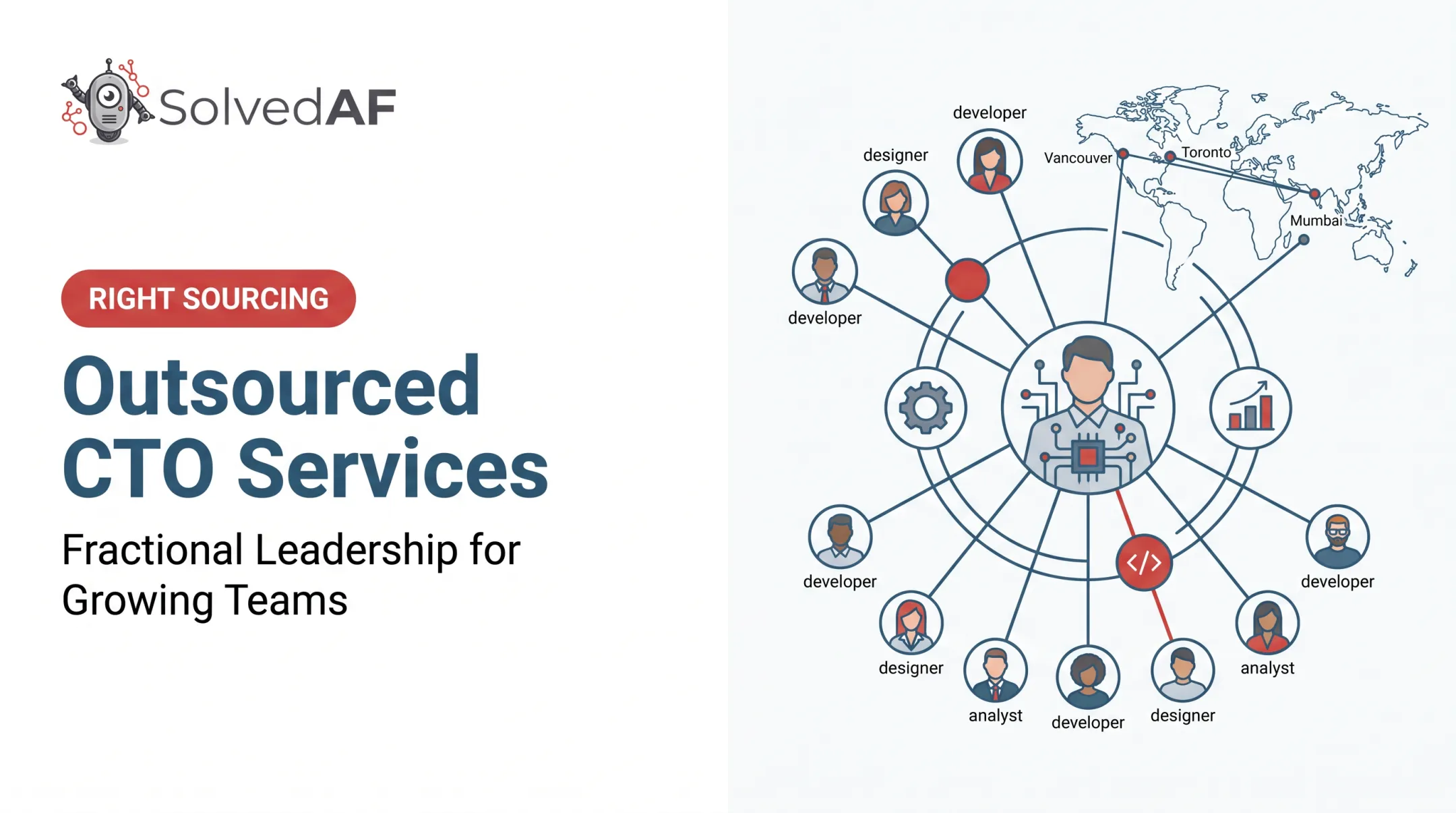
Growing organisations often juggle internal staff, outsourced providers, accounting partners, technology vendors, and offshore or onshore resources. A fractional COO keeps responsibilities and handoffs clear across all of them so nothing falls through the cracks.
SolvedAF works in this space as an integrated partner for startups, SMEs, and nonprofits across North America. It pairs fractional leadership with accounting, technology and AI, risk and compliance, and right-sourcing support.
Its fractional leaders bring experience from organisations such as JP Morgan, Tata Group, lululemon, and Seaspan. The blended model (fractional leadership plus offshore subject-matter experts) is typically priced at about 25–50% of full-time executive cost.
Not every fractional COO engagement includes every service above. Scope should match the mandate.
Benefits and When to Hire a Fractional COO
Why Organisations Bring One In
A fractional COO offers executive-level operating experience without an immediate full-time commitment. That means quicker judgment from operators who have scaled similar businesses, stronger accountability, and clearer processes. Critically, it also frees founder capacity for strategy, customers, fundraising, or product leadership.
This matters more than it might seem. BDC's research on Canadian entrepreneurs found an average workweek of 49.7 hours among those surveyed, with over 40% reporting they feel overwhelmed. More advice rarely fixes that. Delegating recurring operational decisions does.

Signals You May Be Ready
- Recurring execution failures that keep resurfacing despite good intentions
- Unclear ownership across teams or departments
- The founder remains the bottleneck for most operational decisions
- Growth has stalled despite demand, or hiring/post-funding expansion is outpacing structure
- Systems and tools don't talk to each other
- A leadership gap or major transformation is on the horizon
When Something Else Fits Better
Not every operational headache needs a COO:
| Situation | Better fit |
|---|---|
| A narrow, bounded process fix | Specialist or project manager |
| Purely financial strategy or forecasting | CFO or controller |
| Permanent, organisation-wide leadership need | Full-time COO |
Quick decision checklist: Consider urgency, complexity, how much authority the problem requires, your internal capability, available budget, and expected duration, not a single revenue or headcount threshold. A 15-person company mid-transformation might need more operating leadership than a 60-person company with a stable, well-run operation.
How Fractional COO Engagements Work and How to Choose One
Fractional COO work is usually built around a clear scope, a set time horizon, and measurable operating outcomes. Choose the model that matches problem intensity and how much internal ownership you already have.
Common Engagement Models
- Project-based: A defined audit, implementation, restructuring, or systems initiative with agreed deliverables and milestones.
- Ongoing fractional: Recurring leadership, reporting, and operating reviews under a set monthly scope.
- Interim: Higher-intensity coverage during a COO departure, turnaround, or search for permanent leadership.
- Hybrid: A diagnostic or transformation phase followed by lighter ongoing support, or a planned handoff to an internal leader.
A Practical First-90-Day Plan
Harvard Business School's guidance on new executive roles recommends a staged entry: align on expectations, interview stakeholders, synthesise findings, then build a plan with measurable goals. Applied to a fractional COO:
- Days 1-30: Listen to leadership and teams, review data and workflows, set a baseline, and agree on priorities.
- Days 31-60: Design the operating roadmap, clarify ownership, introduce the management cadence, and start priority work.
- Days 61-90: Execute priority initiatives, track KPIs, document processes, train internal owners, and lock the next phase.

What Drives Pricing in Canada
There's no single published CAD average for fractional COO fees across hourly, daily, retainer, and project structures. Job Bank's wage data for Canadian COO occupations shows a median of CAD $96.15/hour in financial and business services, versus CAD $46.04/hour in goods production and related sectors.
Full-time salary benchmarks do not translate directly into a contractor's fee, and sector matters.
What actually moves the price on a fractional engagement:
- Seniority and track record of the individual COO
- Industry specialisation relevant to your business
- Time commitment — a few hours weekly versus near-full-time coverage
- Complexity of the mandate and number of stakeholders involved
- Urgency — interim coverage for an unexpected departure costs differently than planned, ongoing support
Request itemised, comparable written quotes from any provider rather than relying on a headline hourly number.
Vetting and Setting Terms
When evaluating candidates, look for:
- Comparable operating experience and strong references
- Clear communication style and industry or business-model fit
- Reliable availability and change management skill
- A track record of implementing, not only advising
Engagement terms should clearly define:
- Scope, authority, and reporting line
- Deliverables and meeting cadence
- Confidentiality and data access
- Success measures and invoicing terms
- Renewal, exit, and knowledge-transfer expectations
If your organisation needs strategy and implementation under one mandate, SolvedAF can walk through a tailored fractional leadership, operations, or right-sourcing roadmap built around your goals.
Frequently Asked Questions
What is the average cost of a fractional COO?
There's no single reliable Canadian average across hourly, retainer, and project models. Cost depends heavily on scope, seniority, industry, and time commitment, so request itemized CAD quotes rather than relying on a general figure.
What is a typical COO salary and how does it vary by company size?
Full-time COO salary differs from a fractional fee structure. Canadian wage data shows a median around CAD $96.15/hour in business services versus CAD $46.04/hour in goods production, varying by sector and seniority.
What does a fractional COO do?
They lead strategy execution, improve operational processes, build team accountability, oversee systems and resource planning, manage risk, and coordinate cross-functional work, all with delegated decision authority.
What should a COO do in the first 90 days?
Run a diagnostic, prioritize fixes, establish an operating cadence, implement early wins, set a KPI baseline, document processes, and agree on the next phase with leadership.
How long do companies typically use a fractional COO?
It depends entirely on the mandate. Project engagements end at delivery; ongoing and hybrid arrangements can run much longer. There's no universal standard timeframe.
What is a COO and how does that role differ from CEO and CFO?
The COO leads execution and day-to-day operations. The CEO sets overall direction and leads the organization externally. The CFO owns financial strategy, forecasting, and financial risk.